sawmill
For Whom the Bell TollsThe sawmill is a small military post beside the road through the mountain pass, close to the bridge at the center of Robert Jordan’s demolition mission. Its position turns an ordinary working site into part of the battle’s geography: it watches the route, lies within the operation’s line of attack, and links the bridge to the posts that must be overcome before reinforcements can use the road.
Setting and Position
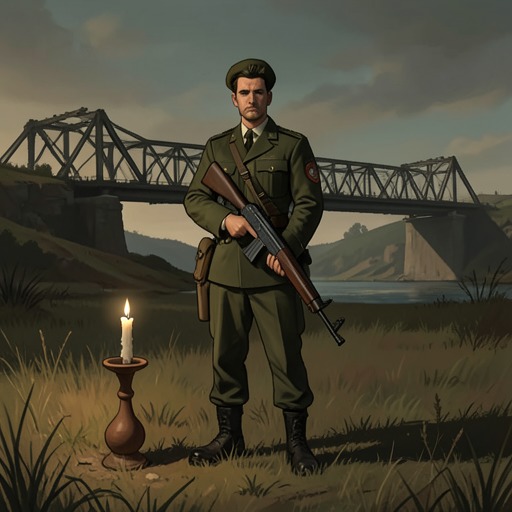
Early in the novel, Robert Jordan lies on a pine-needled mountainside and looks down toward the road, the stream beside it, and a mill near the water and dam. The road winds through the pass below the slope. Later, the bridge is described as a single-span steel structure over a deep gorge, with a sentry box at either end; from the hillside, Jordan studies how its supports can be cut and the span dropped into the gorge. The mill and bridge belong to the same constricted landscape, where slopes, tree cover, water, and the road govern what can be seen and approached.
The Post and the Road
The sawmill houses a small guard detail. During a late-spring snowstorm, Anselmo watches the road from a tree and sees a camouflaged staff car pass beneath him. He records it on the sheets taken from Jordan’s notebook, marking it as the tenth vehicle to go up that day; six have gone down, and four more are still expected up. He cannot distinguish ordinary divisional traffic from the more important cars of the General Staff. The road therefore supplies useful intelligence, but Anselmo’s tally cannot by itself identify the military significance of each vehicle.
Inside the mill, the soldiers’ routine is spare and domestic: one greases his boots on his bunk, another sleeps, a third cooks, and their corporal reads a paper. Helmets hang from nails and rifles lean against the plank wall. Their shelter contrasts with Anselmo’s exposure outside in the snow, while their presence marks the building as a functioning post rather than simply a landmark beside the road.
The Bridge Operation
The sawmill post forms part of the operation’s immediate military problem. Jordan’s instructions require the bridge to be blown only after the attack begins, so that no reinforcements can come up the road. When he assesses the defenses, he points out that rocks meant to protect the flanks of a gun position can instead give cover to attackers, and argues that the weapon must fire across open ground and take the enemy from the side. Terrain around the road and its posts is thus not neutral: the same rocks and approaches can protect one force or expose another, depending on how they are used.
Jordan identifies the sawmill post as a target to be eliminated the following morning, along with the post at the roadmender’s hut below the bridge. The demolition plan depends on coordinated action beyond the bridge itself; disrupting the guards along the route is part of preventing interference with the crossing and the wider attack. Yet the timetable is vulnerable to circumstances beyond the local party’s control. Jordan later considers that the enemy has moved material into position to meet the Republican offensive, while permission to cancel the attack must come from Madrid and may not arrive in time.
Narrative Significance
The sawmill’s significance comes from its position between observation and action. From the wooded slope, Anselmo can count traffic but misses distinctions Jordan would have recognized; inside, the soldiers remain absorbed in ordinary tasks, unaware of the larger operation taking shape around their post. The mill is both an inhabited workplace and a military obstacle, and the snow that shelters and chills the watcher also complicates surveillance and movement. Against the narrow road, the gorge, and the sentry boxes, it helps show how the bridge mission is constrained not only by explosives and orders but by the specific ground through which men and reinforcements must pass.